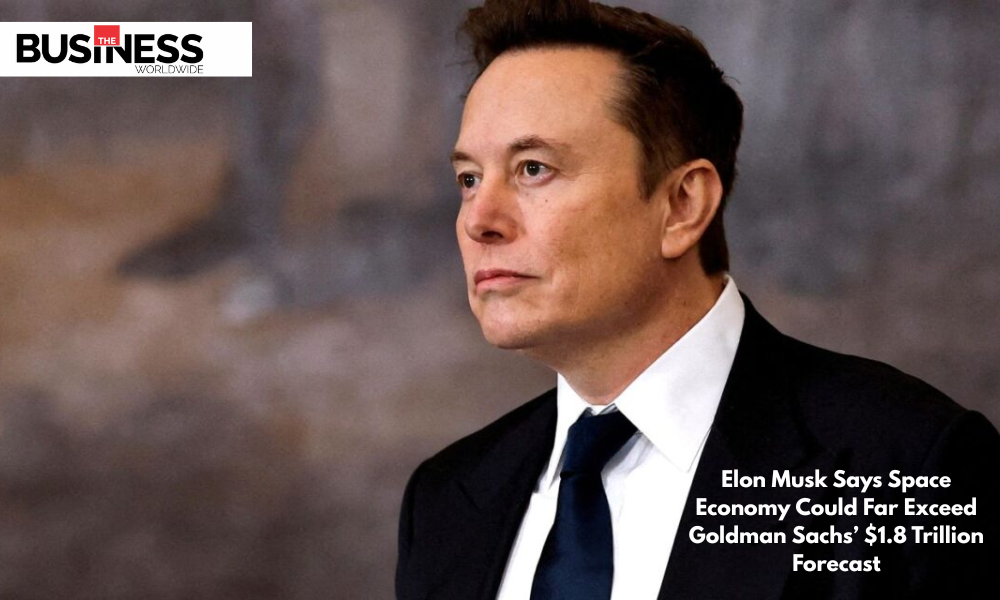
Goldman Sachs has projected that the global space economy could reach $1.8 trillion by 2035, reflecting the accelerating shift from government-led exploration toward private investment, commercial activity and increasingly accessible space technology.
The Elon Musk forecast was highlighted in the investment bank’s August 2026 report, The Second Space Age, which examines how technological advances and growing private-sector participation are reshaping the industry. According to the report, reusable launch vehicles, smaller satellites and declining manufacturing costs are helping establish space as an emerging pillar of the global industrial economy.
Investment momentum is already strengthening. More than $55 billion flowed into the global space ecosystem during 2025, while the first quarter of 2026 alone attracted a record $36 billion, underscoring growing investor confidence in the sector’s long-term potential.
Elon Musk Predicts an Even Larger Opportunity
Elon Musk, founder and CEO of SpaceX, responded to Goldman Sachs’ projection on X with a brief but emphatic assessment: “It will be much bigger.”
Musk’s response reflects his longstanding belief that the commercial opportunity in space could extend well beyond conventional estimates. SpaceX has played a central role in accelerating the commercialization of space through reusable rockets and increasingly frequent launches, while also developing technologies aimed at supporting future missions to the Moon and Mars.
His latest comment suggests that Elon Musk sees the emerging space economy not simply as a launch and satellite market, but as the foundation for a much broader economic ecosystem beyond Earth.
Cryptocurrency and the Future of Space Commerce
Elon Musk has also previously connected cryptocurrency with the potential development of an off-Earth economy. In December 2020, he agreed with AI researcher Lex Fridman’s suggestion that a future Mars economy could operate using cryptocurrency.
The concept moved closer to practical application in 2021, when SpaceX announced the DOGE-1 lunar mission. The company agreed to accept Dogecoin as payment from Geometric Energy Corporation for the launch, marking an unusual intersection between digital assets and commercial space activity.
As private investment continues to accelerate and space technologies become more commercially viable, Musk’s prediction points toward a future in which the economic value generated beyond Earth could significantly surpass today’s expectations.
Also Read :- Grok 4.5 Enters Testing, Elon Musk Says It Could Rival Claude Opus