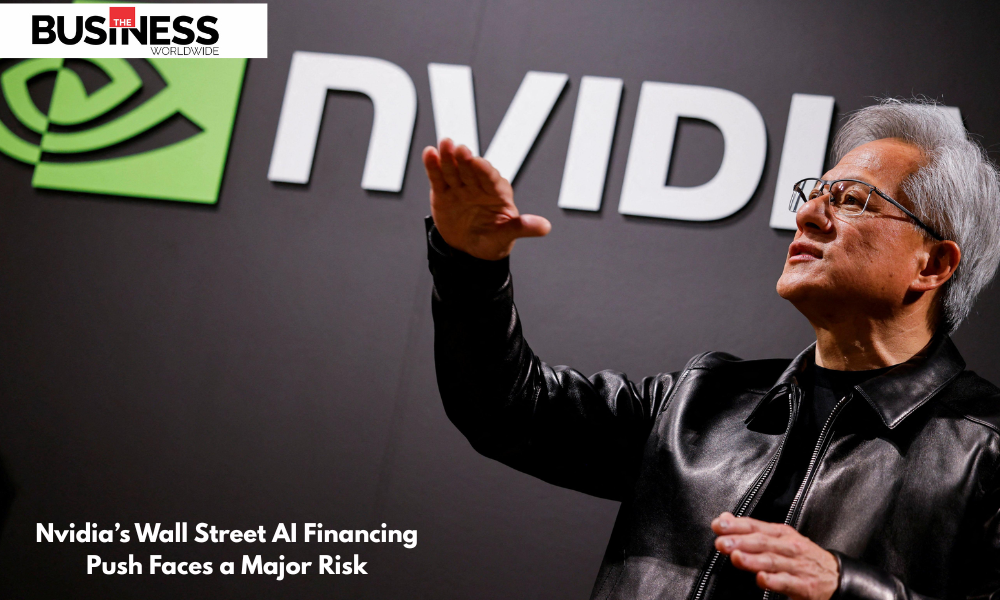
Nvidia is partnering with some of Wall Street’s biggest financial institutions to help accelerate the global build-out of artificial intelligence infrastructure, creating a financing ecosystem that could mobilize hundreds of billions of dollars. However, concerns are growing over whether the structure could amplify financial risks if AI demand fails to meet expectations.
Nvidia Builds a $500 Billion Financing Network
Nvidia is working with Apollo, BlackRock, Blackstone, Brookfield, Goldman Sachs and KKR on financing platforms designed to mobilize more than $500 billion in third-party capital for AI infrastructure over time.
The initiative is aimed at helping data-center developers and other infrastructure operators secure the capital needed to purchase advanced computing equipment and expand capacity as demand for AI continues to surge.
Nvidia has emphasized that the $500 billion figure does not represent revenue or a single committed investment fund. Instead, the financing arrangements involve multiple platforms in which financial institutions will independently evaluate customer demand, infrastructure utilization, cash flows and the residual value of equipment.
Ali Meli, managing partner and chief investment officer at Monachil Capital Partners, has examined the financing structure and highlighted the risks associated with the growing dependence on leveraged capital.
Also Read :- Goldman Sachs Raises SanDisk Price Target as Strong NAND Outlook Fuels Bullish Forecast
The Leverage Question
The financing model has also attracted criticism from Michael Burry, the investor best known for predicting the housing-market collapse ahead of the 2008 financial crisis.
Burry has taken aim at Nvidia’s broader AI-infrastructure financing strategy, arguing that Wall Street could be creating a highly leveraged system around continued demand for GPUs. His concern centers on whether the underlying economics of AI infrastructure can ultimately support the scale of capital being deployed.
According to Burry’s criticism, some structures could involve private credit and asset-backed debt, with Nvidia-related capital potentially helping finance purchases of Nvidia GPUs. Such arrangements could create interconnected exposures if demand, utilization or cash flows weaken.
AI Boom Meets Financial Risk
The debate highlights a critical question for the AI investment cycle: whether soaring demand for computing infrastructure is being driven primarily by sustainable end-user economics or increasingly sophisticated financing mechanisms.
For Nvidia and its financial partners, access to capital can accelerate data-center construction and expand the company’s addressable market. But if AI infrastructure operators struggle to generate sufficient returns, leverage could magnify losses across the financing chain.
As Wall Street commits increasingly large sums to AI infrastructure, the sustainability of the boom may depend not only on GPU demand, but also on whether the economics behind that demand remain strong.
Also Read :- Nvidia Revives RTX 3060 Graphics Card Amid Rising Memory Costs and GPU Demand