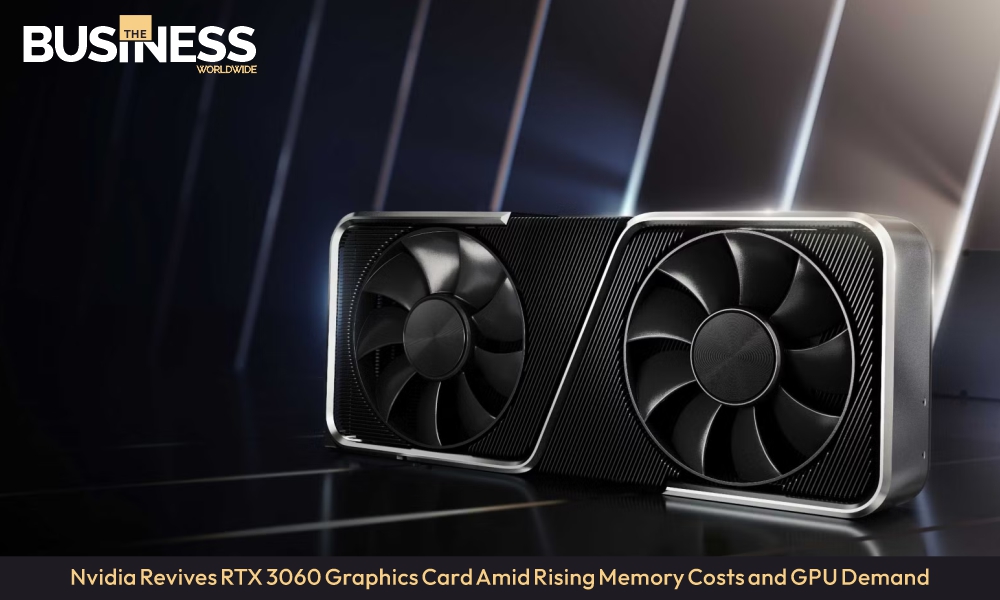
Nvidia has quietly brought one of its older graphics cards back to the market, signalling an effort to ease pressure on the graphics processing unit (GPU) supply chain as rising memory costs continue to influence hardware pricing. However, while the move offers gamers another purchasing option, the pricing has raised questions about the overall value proposition.
The company has reportedly begun restocking its GeForce RTX 3060 graphics cards through select online retailers, giving consumers access once again to a GPU that first debuted in 2021. Although the return of the popular graphics card may help expand supply in the mainstream gaming market, the price places it surprisingly close to newer-generation alternatives.
RTX 3060 Returns to Retail Shelves
According to reports from technology publication Tom’s Hardware, Nvidia has quietly resumed shipments of the 12GB GeForce RTX 3060, with listings appearing at online retailers such as Newegg. The graphics card had largely disappeared from retail channels after Nvidia shifted its production focus toward its latest RTX 50-series lineup.
The RTX 3060 has long been regarded as a dependable mid-range graphics card capable of delivering solid gaming performance across a wide range of modern titles. Its 12GB of video memory also makes it suitable for content creation workloads and entry-level AI applications, helping it remain relevant despite its age.
The renewed availability is expected to provide consumers with an additional option at a time when demand for GPUs continues to outpace supply in certain market segments.
Pricing Raises Concerns
Despite the return of the older model, the pricing has attracted criticism. The RTX 3060 has reportedly reappeared with a retail price of $339.99, only marginally cheaper than Nvidia’s newer and significantly more capable GeForce RTX 5060.
The narrow price difference has led many industry observers to question whether consumers would be better served by investing in the latest generation, which offers improved performance, greater energy efficiency, and support for newer technologies.
For budget-conscious buyers, the expectation was that reintroducing older inventory would provide a more affordable entry point into PC gaming. Instead, the current pricing leaves relatively little financial incentive to opt for the five-year-old GPU.
Addressing Market Demand
Nvidia’s decision appears to be aimed at increasing the overall supply of graphics cards rather than replacing its latest product lineup. While the RTX 3060 lacks many of the advanced features available in the RTX 50-series, it remains capable of delivering smooth performance in the vast majority of contemporary PC games, particularly at 1080p and 1440p resolutions.
Earlier this year, during the Consumer Electronics Show (CES), Nvidia CEO Jensen Huang indicated that the company was considering bringing select legacy products back into production if market conditions warranted it. The latest restocking suggests Nvidia has followed through on that strategy.
Although the move may help alleviate pressure in the GPU market, the relatively high asking price means that gamers seeking value may still find themselves weighing older hardware against newer, more future-ready alternatives. The development reflects the broader challenges facing the technology industry as component costs, particularly for memory, continue to influence pricing across the PC hardware market.
Also Read :- Nvidia Claims New AI Infrastructure Could Significantly Reduce Data Center Water Usage