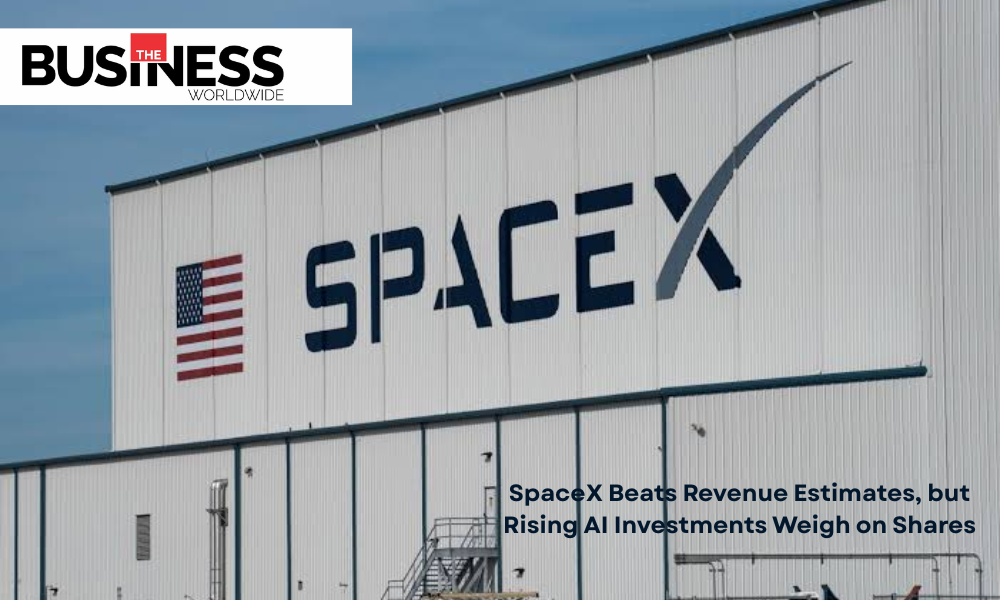
SpaceX reported stronger-than-expected second-quarter results in its first earnings release since its record-setting initial public offering (IPO) in June. Despite robust revenue growth and a narrower-than-expected loss, the company’s shares fell about 8% in extended trading as investors focused on soaring capital expenditures tied to artificial intelligence (AI) investments.
The Elon Musk-led company posted revenue of $7.81 billion, surpassing analysts’ estimates of $6.93 billion, according to LSEG. SpaceX reported a loss of 9 cents per share, significantly better than the expected loss of 26 cents per share.
Revenue surged 92% year-on-year from $4.1 billion, while net losses narrowed to $541 million, compared with $1 billion in the same period last year. However, the stock has declined around 16% since debuting at $150 on June 12, reflecting investor concerns over profitability.
AI Investments Continue to Pressure Earnings
SpaceX’s financial performance continues to be weighed down by aggressive spending on AI infrastructure. The company reported a $4.9 billion loss in 2025, largely driven by investments following its merger with Musk’s AI venture, xAI, earlier this year. The merger supports the company’s long-term vision of developing AI-powered data centers in space.
Even its core launch business, supported by contracts from NASA and the U.S. Department of Defense, remained unprofitable. During the quarter, the space segment generated $962 million in revenue, above expectations of $835 million, but recorded an operating loss of $542 million.
The AI division also outperformed revenue estimates, generating $2.56 billion against expectations of $2.18 billion, though it posted an operating loss of $1.26 billion.
Starlink Drives Profitability
SpaceX’s connectivity business, anchored by its Starlink satellite internet service, remained the company’s strongest performer. The segment generated $4.29 billion in revenue, exceeding forecasts of $3.83 billion, and delivered an operating profit of $1.66 billion, making it the company’s only profitable business.
Starlink Mobile Expansion Underway
President and COO Gwynne Shotwell said SpaceX expanded Starlink Mobile partnerships during the quarter with international telecom operators, including SoftBank, NTT DoCoMo and Spark New Zealand.
The company plans to launch next-generation Starlink V2 satellites aboard Starship before integrating EchoStar spectrum next year, following recent FCC approval. Shotwell said SpaceX expects to begin serving U.S. mobile customers—including those of AT&T, Verizon and T-Mobile—as early as next year, with a standalone Starlink Mobile service targeted for launch by the end of 2027.
Also Read :- Grok 4.5 Enters Testing, Elon Musk Says It Could Rival Claude Opus