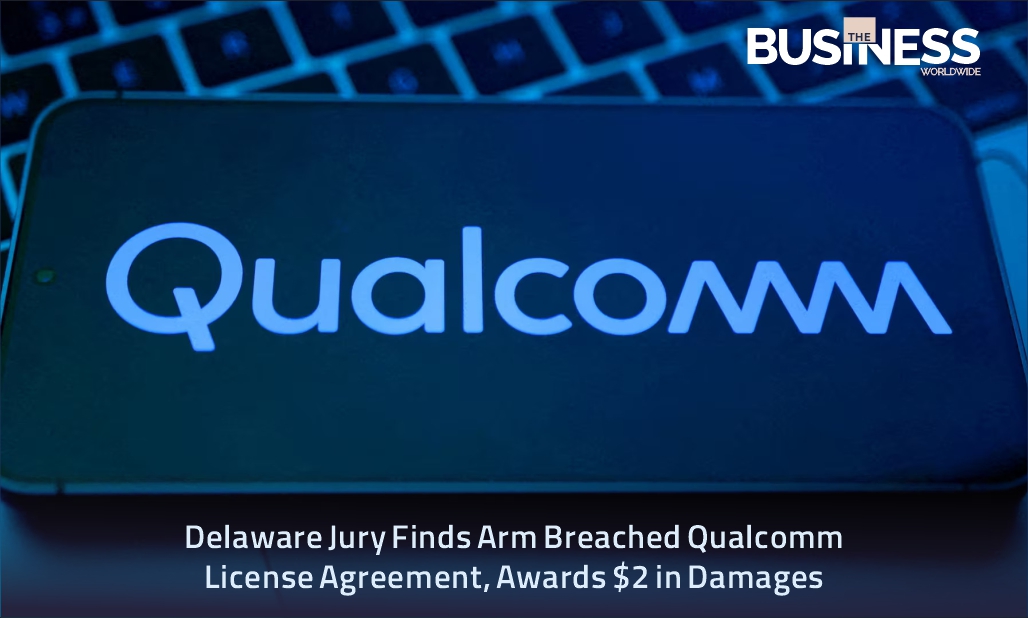
A Delaware jury on Tuesday found that chip technology company Arm Holdings breached its licensing agreement with Qualcomm and intentionally interfered with the chipmaker’s business relationship with Meta Platforms. However, the jury awarded Qualcomm just $2 in nominal damages, leaving several important legal and financial questions unresolved.
The verdict followed a five-day trial last week, marking the second legal battle between the companies in two years. The dispute highlights the deterioration of their relationship after SoftBank Group acquired control of Arm in 2016. Tensions have grown as Arm moved beyond licensing technology used to develop chips and began selling its own chip products.
Following the verdict, Arm’s shares fell 1%, while Qualcomm’s stock rose 1%. However, Qualcomm’s gains were lower than the approximately 2.4% increase recorded before the decision.
Both Companies Claim Partial Victory
Qualcomm welcomed the Delaware Jury findings, saying Arm had breached its long-standing Architectural License Agreement (ALA), failed to meet its commitments and deliberately attempted to disrupt Qualcomm’s business operations.
Arm also described the outcome as favourable, arguing that the $2 award supported its position that it had acted in good faith under the licensing agreement. The company maintained that Qualcomm had pursued the lawsuit in an attempt to obtain billions of dollars under the contract.
The Delaware Jury found that Arm had breached its obligation to provide software patches and tools for its chip designs. However, it sided with Arm on five other allegations of contractual breaches, resulting in a mixed outcome for both parties.
Dispute Over Meta Business Deal
The jury also concluded that Arm had intentionally and negligently interfered with Qualcomm’s business relationship with Meta. Qualcomm alleged that it was close to securing a deal with Meta in 2024 when Arm reportedly disclosed to Bloomberg News that Qualcomm had violated a licensing agreement.
According to Qualcomm, the disclosure delayed the potential agreement. The jury awarded $1 for each of the two interference claims, bringing the total damages to $2.
Billions of Dollars at Stake
Despite the small damages award, the case could have significant financial implications. The breach finding leaves open the possibility that US District Judge Maryellen Noreika could allow Qualcomm to stop paying royalties to Arm for five years, potentially saving Qualcomm billions of dollars.
Arm has challenged the enforceability of the contractual provision that could trigger the five-year royalty penalty. Judge Noreika will need to resolve several outstanding disputes in the next phase of the proceedings, leaving the final financial consequences uncertain.
Also Read :- AI Pivot Could Drive Salesforce Shares Higher, Says Bank of America