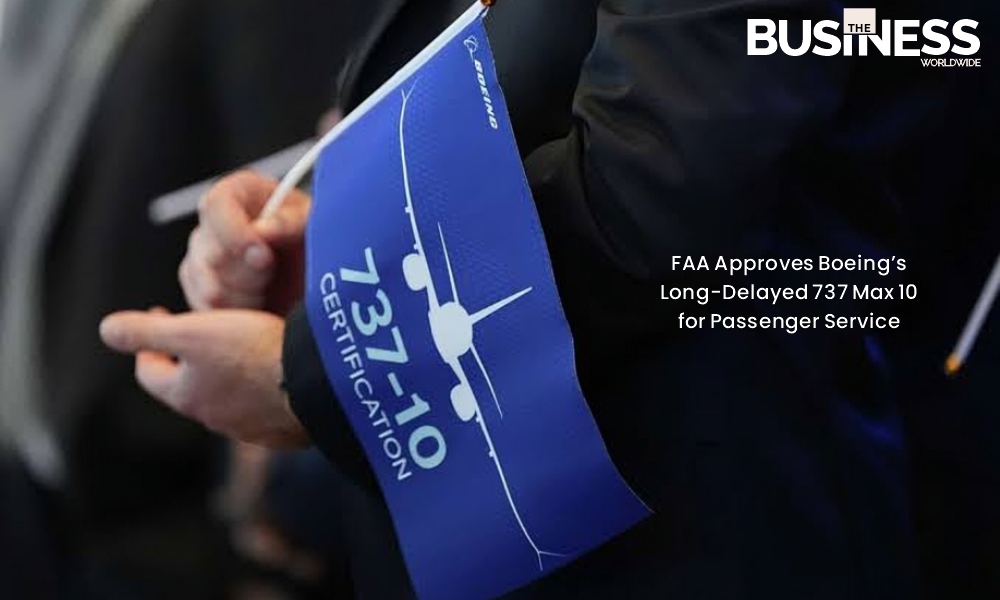
The US Federal Aviation Administration (FAA) has approved Boeing’s 737 Max 10 for passenger service, marking a significant breakthrough for the aircraft manufacturer after nearly a decade of delays. Unveiled almost 10 years ago, the largest aircraft in Boeing’s 737 Max family received the regulatory clearance on Tuesday, paving the way for its entry into commercial airline fleets.
The certification marks an important step in Boeing’s efforts to rebuild its reputation and strengthen its financial position after years of safety concerns, manufacturing quality issues, and production setbacks. With the approval secured, Boeing can move forward with delivering the aircraft to domestic and international airlines.
Transportation Secretary Sean Duffy said the approval followed extensive safety assessments, including thousands of hours of test flights. He described the development as a major achievement for American manufacturing.
Speaking during a visit to Boeing’s manufacturing facility in Everett, Washington, on Tuesday, Duffy acknowledged the lengthy certification process. “To think that it took us almost 10 years to get here. We all probably had a little less gray hair 10 years ago,” he said.
Boost for Boeing’s 737 Max Narrow-Body Business
The Boeing’s 737 Max 10 is a crucial component of Boeing’s strategy to regain market share in the narrow-body aircraft segment, where competition remains intense. The aircraft is designed to carry more passengers than the smaller models in the 737 Max family, making it an attractive option for airlines seeking greater capacity and operational efficiency.
According to Boeing, the Max 10 typically seats 185 to 210 passengers. By comparison, the 737 Max 9 seats approximately 175 to 195 passengers, while the Max 8 generally accommodates 160 to 180 passengers.
The additional seating capacity could help airlines reduce operating costs per passenger, particularly on busy routes with strong demand. For travellers, the aircraft could eventually increase seat availability on popular services. However, any impact on ticket prices will depend on airline deployment strategies, operating costs and the level of competition in individual markets.
Boeing’s 737 Max Sees Opportunity for Growth
Stephanie Pope, president and chief executive of Boeing Commercial Airplanes, welcomed the certification, describing it as a significant achievement after years of effort by the company’s workforce. She said the approval clears the way for the delivery of an aircraft expected to establish a new benchmark in commercial aviation.
“Today is a very, very special day. It caps years of hard work and dedication by many,” Pope said, adding that the milestone supports Boeing’s recovery and opens up opportunities for future growth.
The approval strengthens Boeing’s position as it works to overcome past challenges, expand deliveries and meet airline demand. The aircraft’s commercial success will now depend on the company’s ability to ramp up production, deliver planes to customers and maintain the safety and quality standards essential to restoring confidence in its products.
Also Read :- Oracle Expands AI Capabilities in HR with Launch of Manager EdgeThe approval strengthens Boeing’s position as it works to overcome past challenges, expand deliveries and meet airline demand. The aircraft’s commercial success will now depend on the company’s ability to ramp up production, deliver planes to customers and maintain the safety and quality standards essential to restoring confidence in its products.
Also Read :- Oracle Expands AI Capabilities in HR with Launch of Manager Edge